
Professional Development at ETI Malta and the Educational Potential of AI and Virtual Reality
Professional Development, Artificial Intelligence and Immersive Learning at the Executive Training Institute in Malta
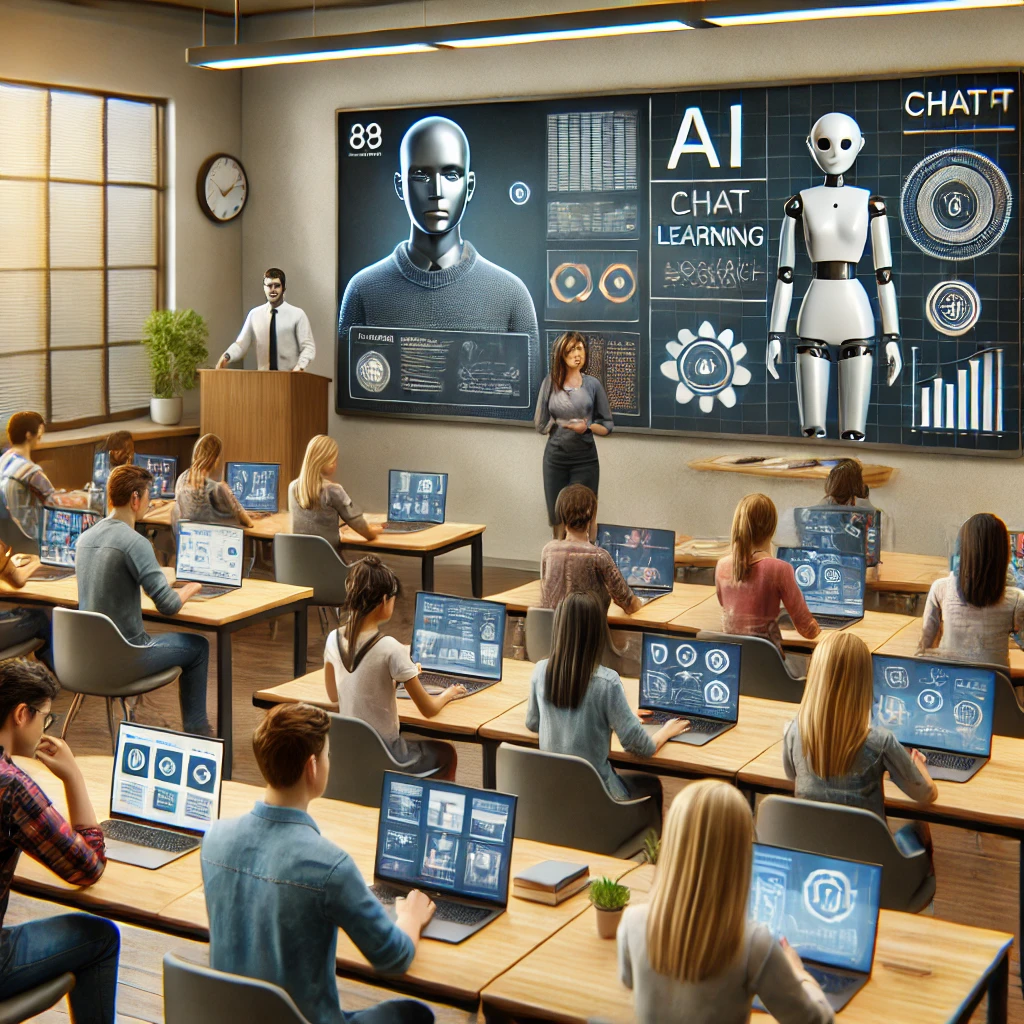
Artificial intelligence, immersive technologies and rapidly developing digital learning environments are transforming education. The central question for teachers is no longer whether technology will become part of education, but how it can be integrated into teaching in a pedagogically meaningful, ethical and evidence-informed way.
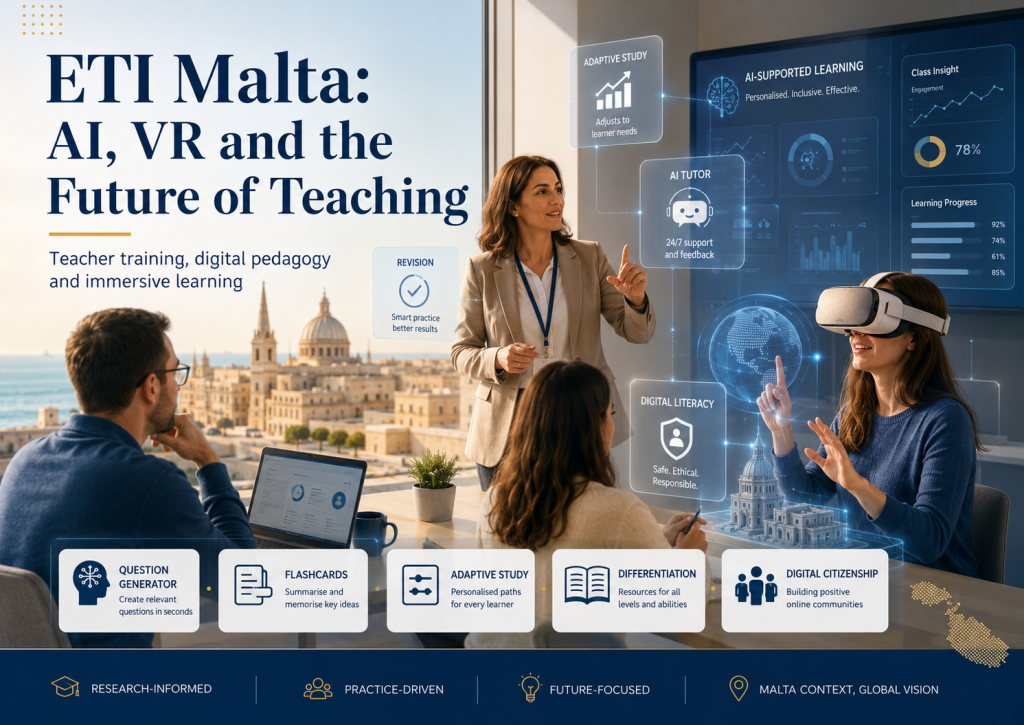
The Executive Training Institute (ETI) in Malta provides an interesting European example of this transition. Based in St Julian’s, ETI specialises in professional English, communication training and Continuing Professional Development (CPD), with a particularly extensive portfolio for educators. Its teacher-training philosophy emphasises active participation, practical experimentation and the connection between pedagogical theory and classroom practice. ETI’s teacher-development courses are also eligible for Erasmus+ funding and bring together educators from different European countries, creating opportunities for international professional exchange.
Rather than presenting technology as a replacement for established pedagogy, ETI’s approach places digital tools within the broader framework of teacher competence, methodology, communication and reflective practice.
ETI Malta: More Than a Language School
ETI offers several major areas of professional training. Its programmes include Professional English and Communication, teacher education and international team and leadership development. For educators specifically, the portfolio is remarkably broad.
Current teacher-training opportunities include Content and Language Integrated Learning (CLIL), English language development, ICT and Technology Enhanced Learning, primary teaching methodology, secondary and higher-level language methodology, professional communication, intercultural education, neurodiversity and Special Educational Needs, academic writing, creativity, and technology-oriented courses involving artificial intelligence and immersive environments.
The educational model is strongly experiential. Participants do not simply listen to presentations about teaching techniques; they are encouraged to perform activities themselves, examine them from a learner’s perspective, discuss their pedagogical value and then consider how they could be adapted to their own classrooms. ETI describes its programmes as interactive and hands-on, explicitly connecting theory with practice.
This is particularly important in technology training. Teachers need more than lists of websites. They need opportunities to explore when a digital tool is appropriate, what cognitive process it supports, what its limitations are, and whether it genuinely improves learning.
From Digital Tools to Digital Pedagogy
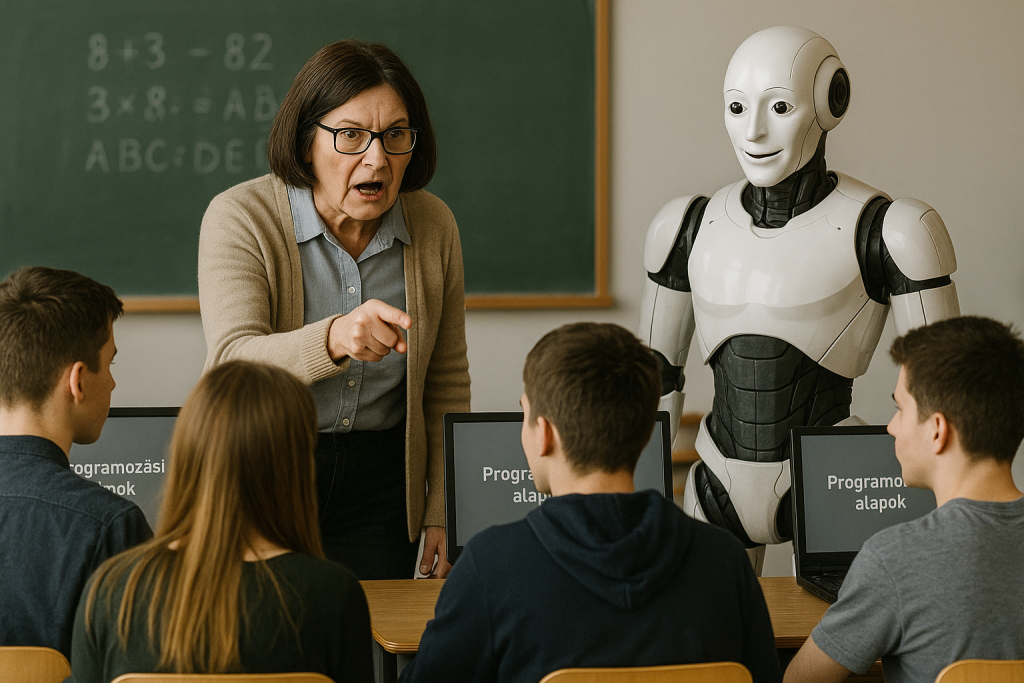
One of the most significant developments in contemporary education is the transition from conventional educational technology to AI-supported learning environments.
Generative AI can already assist teachers in producing questions, adapting texts, generating revision materials, creating differentiated tasks and designing preliminary learning pathways. However, the educational value of these systems does not lie in automation alone.
Their real value emerges when technology is connected with established pedagogical principles such as:
retrieval practice, formative assessment, scaffolding, differentiation, adaptive learning, feedback, metacognition and learner autonomy.
Several contemporary platforms illustrate different dimensions of this transformation.
Thea – Adaptive Study and Retrieval Practice
Thea (thea.study) focuses primarily on transforming teaching or learning materials into structured study resources.
Teachers can upload or describe their own material and create Study Kits containing adaptive questions, flashcards, practice tests, games and study guides. The Smart Study system presents different types of questions, including multiple-choice, true/false and short-answer tasks, while adapting subsequent practice according to student performance. Students can also receive immediate feedback.
From a pedagogical perspective, this is particularly interesting because it moves students away from exclusively passive revision.
Simply rereading a textbook is not equivalent to actively attempting to retrieve information from memory. Research on learning has repeatedly demonstrated the value of retrieval practice and distributed practice for long-term retention. Consequently, AI-generated questions become most useful when teachers use them as part of a deliberate retrieval strategy rather than simply generating large quantities of exercises.
For teachers, Thea can therefore support homework preparation, revision programmes, flipped-classroom activities, diagnostic practice and independent learning.
The teacher’s role remains essential: generated questions should be checked for factual accuracy, linguistic appropriacy, level and alignment with the intended learning objectives.
Revisely – Turning Teaching Materials into Assessment Resources
Revisely (revisely.com) provides AI-supported flashcard, quiz and notes-generation tools for students, educators and professionals.
Its systems can transform material from text, images, PDFs, PowerPoint presentations and other documents into revision resources. Its AI Quiz Generator can produce questions from uploaded teaching material, while its flashcard system supports practice and testing. Revisely’s Notes tools can additionally summarise and restructure written material.
For teachers, the most obvious benefit is rapid formative-assessment design.
A chapter from a textbook might, for example, be transformed into:
| Teaching objective | Possible use of Revisely |
|---|---|
| Check prior knowledge | Short diagnostic quiz |
| Vocabulary development | AI-generated flashcards |
| Reading comprehension | Questions generated from a text |
| Revision | Practice quiz or exam mode |
| Independent learning | Student-created revision materials |
| Differentiation | Different sets of questions based on the same source |
This can significantly reduce the mechanical workload involved in producing first drafts of classroom materials.
However, automated question generation should not be confused with assessment design expertise. A human teacher must still decide what is worth assessing. A perfectly grammatical question can still be pedagogically irrelevant.
TutorAI – Personalised Learning Pathways
TutorAI (tutorai.me) represents another model: the AI-supported personal tutor.
Its current platform allows users to select a topic and generate a customised course. Users can also upload their own source material and define or modify a course structure before generating the learning programme. TutorAI describes its environment as including lessons, quizzes, flashcards, learning pathways and progress-related functions.
This model has considerable potential for independent and personalised learning.
A teacher could use such a platform to create supplementary learning pathways for students who require additional practice or enrichment. In language education, for example, one learner may need extra work on vocabulary while another may require additional grammar or communication practice.
It also provides opportunities for flipped learning: basic content exploration can take place independently, leaving classroom time for discussion, problem solving, collaborative tasks and teacher feedback.
Nevertheless, AI tutoring should be viewed as a supplement to professional teaching rather than a substitute for it. Human teachers understand classroom relationships, motivation, cultural context, emotional signals and individual circumstances at a level that automated systems cannot reliably reproduce.
Common Sense Education – Developing AI Literacy, Not Just AI Usage
Common Sense Education (commonsense.org) occupies a different but extremely important position.
It is less significant as an AI content generator and more valuable as a resource for digital citizenship, media literacy, technology evaluation and AI literacy.
Common Sense Education provides materials helping teachers and students examine how artificial intelligence works, how bias may enter AI systems, how generated information should be evaluated and how technology can be used responsibly.
Its recent guidance emphasises that AI literacy must extend beyond learning how to operate a chatbot. Educators and students need to understand the limitations of generated content, misinformation, privacy, consent, bias and responsible digital behaviour. Common Sense research has also argued that professional learning for teachers is fundamental if schools want to introduce AI responsibly.
This is a crucial distinction.
Knowing how to use AI is a technical skill. Knowing when to trust, question, reject or ethically limit AI is a form of literacy.
Future education requires both.
ToolBaz – Rapid Content and Question Generation
ToolBaz (toolbaz.com) contains a broad collection of generative AI tools. From a teacher’s perspective, one of its most immediately applicable functions is its AI Question Generator, which can transform source material into questions for revision, classroom discussion or comprehension activities.
Because it is a general-purpose AI environment rather than a dedicated pedagogical platform, its strongest classroom role may be as a rapid ideation and drafting assistant.
Teachers could use it to generate preliminary:
lesson questions, discussion prompts, comprehension tasks, warm-up ideas, writing prompts or alternative explanations.
The distinction between preliminary and final material is important. AI-generated content should ideally enter a human-in-the-loop workflow:
teacher objective → AI draft → teacher evaluation → adaptation → classroom use → student feedback
This model preserves efficiency without transferring pedagogical decision-making to the machine.
Diffit – AI-Supported Differentiation
Among the platforms discussed here, Diffit (web.diffit.me) is particularly relevant to one of the most difficult challenges in modern classrooms: differentiation.
Teachers frequently work with students who share the same classroom but have substantially different reading abilities, vocabulary knowledge, language proficiency, learning needs and levels of prior knowledge.
Diffit allows educators to adapt materials while maintaining a common central topic. The platform can provide modified texts, vocabulary scaffolds, graphic organisers and questions at different levels of complexity. It also provides specific support for multilingual learners and allows resources to be exported into familiar teacher workflows including Google and Microsoft platforms.
This has significant implications for inclusive education.
Differentiation should not simply mean giving weaker students less. Ideally, it means providing different levels of scaffolding that allow learners to access the same intellectually meaningful content.
AI can make this process substantially faster.
According to Diffit’s own published information, the platform is designed specifically for teachers and states that it does not collect student data, although schools should always independently examine the privacy, safeguarding and data-processing policies of any educational technology before adoption.
Connecting Teaching, Technology and Professional Development
ETI’s official trainer profile confirms that Borg joined the institute in 2021. She works as a trainer on both the Fluency and English Development programme and CPD teacher-training courses, with particular specialisation in Technology in the Classroom and CLIL programmes.
Her professional background is notably interdisciplinary. Before joining ETI, she had accumulated more than 15 years of teaching experience. She also has professional experience in project management, online services and customer care within the insurance sector. Academically, she holds a CELTA qualification, a Master’s degree in Sustainable Architecture and a BA Honours degree in International Development.
Such a multidisciplinary profile is particularly relevant to contemporary teacher education.
Modern digital pedagogy increasingly requires educators to move between disciplines: communication, technology, project design, sustainability, languages and critical digital literacy are becoming interconnected. Effective technology training therefore requires more than technical knowledge. It requires the ability to translate technological possibilities into meaningful learning activities.
Borg’s combination of extensive classroom experience and technology-focused teacher training makes her professional profile especially relevant to ETI’s broader emphasis on experiential and technology-enhanced learning.
Virtual Reality, Augmented Reality and AI at ETI
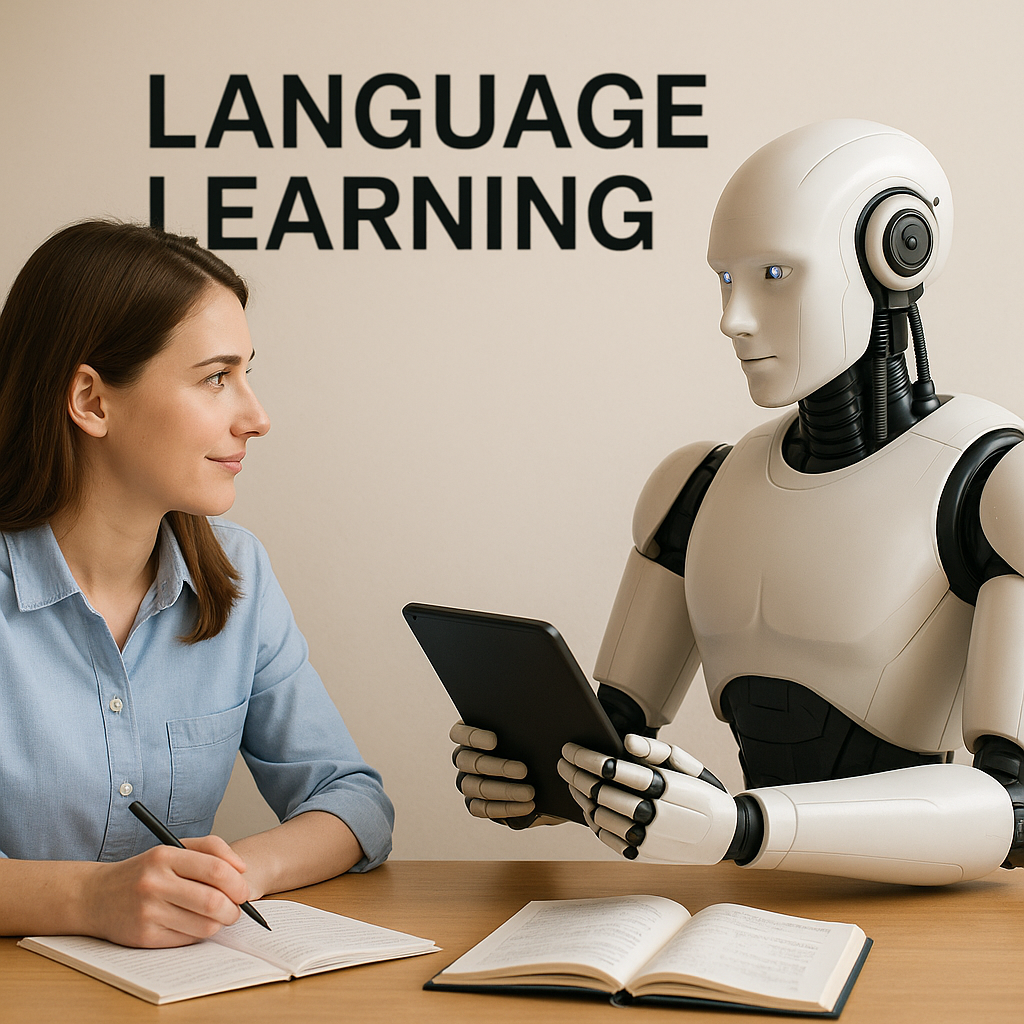
ETI currently offers an intensive course entitled Virtual Reality (VR), Augmented Reality (AR) & Artificial Intelligence (AI) in the Classroom.
The programme introduces educators to AI, VR, AR, simulation learning and gaming while encouraging them to evaluate these technologies in relation to their own educational environments.
The current course format consists of 25 hours over five training days, with a maximum group size of 12. A minimum English level of B1 is required. Importantly, specialised technological knowledge is not required; the programme is designed as an accessible introduction for educators.
Its methodology includes collaborative projects, workshops, brainstorming, problem solving and reflection. Teachers experience technologies themselves before considering how they could be transferred to classroom practice.
This experiential component is particularly appropriate for VR.
Why Virtual Reality Can Matter in Education
Virtual Reality is sometimes presented as if immersion automatically improves learning. Scientific evidence suggests a more nuanced conclusion.
A major meta-analysis by Coban, Bolat and Goksu (2022) combined 105 effect sizes from 48 experimental studies involving 3,179 students. The researchers found a statistically positive overall effect of immersive VR on learning, although the effect was relatively modest (Hedges’ g = 0.38).
In language education, the results are particularly interesting.
A 2024 meta-analysis by Yu and Duan, based on 41 randomised controlled studies, concluded that VR-supported language learning was associated with reduced anxiety and improvements in motivation, performance, satisfaction and self-efficacy compared with traditional learning approaches.
Another meta-analysis examining VR-assisted language learning reported positive effects on both linguistic and affective learning outcomes, with especially promising findings for areas such as speaking, listening and vocabulary.
For language teachers, these findings are easy to contextualise.
Instead of merely discussing checking into a hotel, students can practise communication within a simulated hotel environment.
Instead of describing an airport, they can navigate one.
Instead of learning vocabulary connected with a museum, historic city or workplace only from photographs, students can explore a simulated environment and use language in context.
VR therefore has the potential to transform vocabulary and communicative structures from abstract information into situated experience.
Presence, Authenticity and Experiential Learning
One of VR’s defining psychological characteristics is presence: the subjective feeling of being located inside a mediated environment.
Educationally, presence may make simulated experiences feel meaningful and memorable. Learners can observe environments, make decisions, communicate and interact with objects rather than simply receiving information.
This creates particularly interesting opportunities for subjects where spatial, procedural or contextual knowledge matters.
Potential applications include language role-play, vocational training, science simulations, historical reconstruction, geography, architecture, workplace safety and intercultural communication.
For vocational education, students may eventually practise procedures within simulated environments before encountering real equipment.
For language learners, VR can provide something equally valuable: a communicative context.
The language is no longer an isolated grammar exercise. It becomes a tool required to accomplish a task.
VR Is Powerful — but Pedagogy Must Come First
Scientific research also provides an important warning.
A 2025 systematic review by Poupard, Larrue, Sauzéon and Tricot, analysing 36 studies of immersive technologies, concluded that the relationship between immersion and learning is complex. VR can introduce extraneous cognitive load, particularly for novice learners. In other words, if students must simultaneously understand new subject matter, navigate an unfamiliar virtual environment and operate complicated equipment, the technology itself may consume cognitive resources required for learning.
This leads to a fundamental principle of educational technology:
The most immersive lesson is not necessarily the most effective lesson.
A VR experience should therefore have a clear instructional purpose.
Teachers need to ask:
What can students understand, practise or experience in VR that would be difficult to achieve equally well using a textbook, video, demonstration or classroom activity?
If there is no convincing answer, VR may simply add technological complexity.
If there is a convincing answer, however, immersive learning can provide experiences that conventional classroom environments cannot easily reproduce.
The Teacher as Designer, Evaluator and Ethical Decision-Maker
AI does not remove the need for teachers. In many ways, it increases the importance of professional judgement.
When content can be generated almost instantly, educational expertise shifts increasingly toward selection, evaluation and instructional design.
A teacher using Thea, Revisely, TutorAI, ToolBaz or Diffit must decide whether generated content is accurate and age-appropriate. A teacher using VR must determine whether immersion supports the learning objective or merely creates novelty. A teacher using Common Sense Education resources must help students understand why AI outputs require critical evaluation.
The emerging professional model can therefore be described as the teacher-in-the-loop.
Technology generates possibilities.
The teacher evaluates them.
Pedagogy determines how they are used.
Students remain the central participants in the learning process.
ETI Malta and the Changing Meaning of Teacher Professional Development
The significance of institutions such as ETI extends beyond learning to operate individual applications.
AI tools change rapidly. A platform that is popular today may disappear, change its business model or be replaced by something more capable within a few years.
Consequently, sustainable teacher education cannot focus exclusively on particular products.
Teachers need transferable competencies:
critical AI literacy, effective prompting, evaluation of generated information, instructional design, differentiation, digital citizenship, technological adaptability and evidence-informed decision-making.
ETI’s combination of methodology, language development, international collaboration and technology training provides an environment in which these competences can be explored together. Its emphasis on hands-on experimentation is especially valuable because educators can first experience digital tools from the learner’s perspective before deciding whether and how to introduce them into their own classrooms.
Conclusion: Technology Should Amplify Teaching, Not Replace It
The next generation of education will almost certainly involve artificial intelligence, adaptive learning systems and increasingly immersive digital environments.
Platforms such as Thea, Revisely, TutorAI, Common Sense Education, ToolBaz and Diffit already demonstrate how diverse this ecosystem has become. Some support retrieval practice; others automate preliminary assessment design, create personalised learning pathways, support differentiation or develop AI and digital literacy.
Virtual Reality introduces another dimension: the possibility of turning learning into an experience rather than merely a representation of an experience.
Yet technology itself is not pedagogy.
The strongest educational model is therefore neither completely traditional nor completely automated. It is a carefully designed combination of human expertise and technological capability.
The teacher remains responsible for selecting objectives, designing meaningful activities, evaluating information, supporting students, providing human feedback and creating the social conditions in which learning takes place.
AI can generate.
VR can simulate.
Digital platforms can differentiate.
But teachers give these technologies educational purpose.
That may ultimately be the most important lesson of technology-enhanced teacher training at ETI Malta.
Selected Academic References
Coban, M., Bolat, Y. I., & Goksu, I. (2022). The potential of immersive virtual reality to enhance learning: A meta-analysis. Educational Research Review, 36, 100452. doi:10.1016/j.edurev.2022.100452.
Poupard, M., Larrue, F., Sauzéon, H., & Tricot, A. (2025). A systematic review of immersive technologies for education: Learning performance, cognitive load and intrinsic motivation. British Journal of Educational Technology, 56, 5–41. doi:10.1111/bjet.13503.
Yu, Z., & Duan, P. (2024). Meta-analyses of anxiety, motivation, performance, satisfaction, and self-efficacy in virtual reality-assisted language education. Foreign Language Annals, 57(2), 550–580. doi:10.1111/flan.12748.
Digital and Institutional Sources
Information about ETI courses and Josefa Borg was verified against the official Executive Training Institute Malta website. Platform functionality was checked against current information published by Thea, Revisely, TutorAI, Common Sense Education, ToolBaz and Diffit.
Information and platform features reviewed in August 2026. Digital services and individual course details may change over time.