
Food for thought
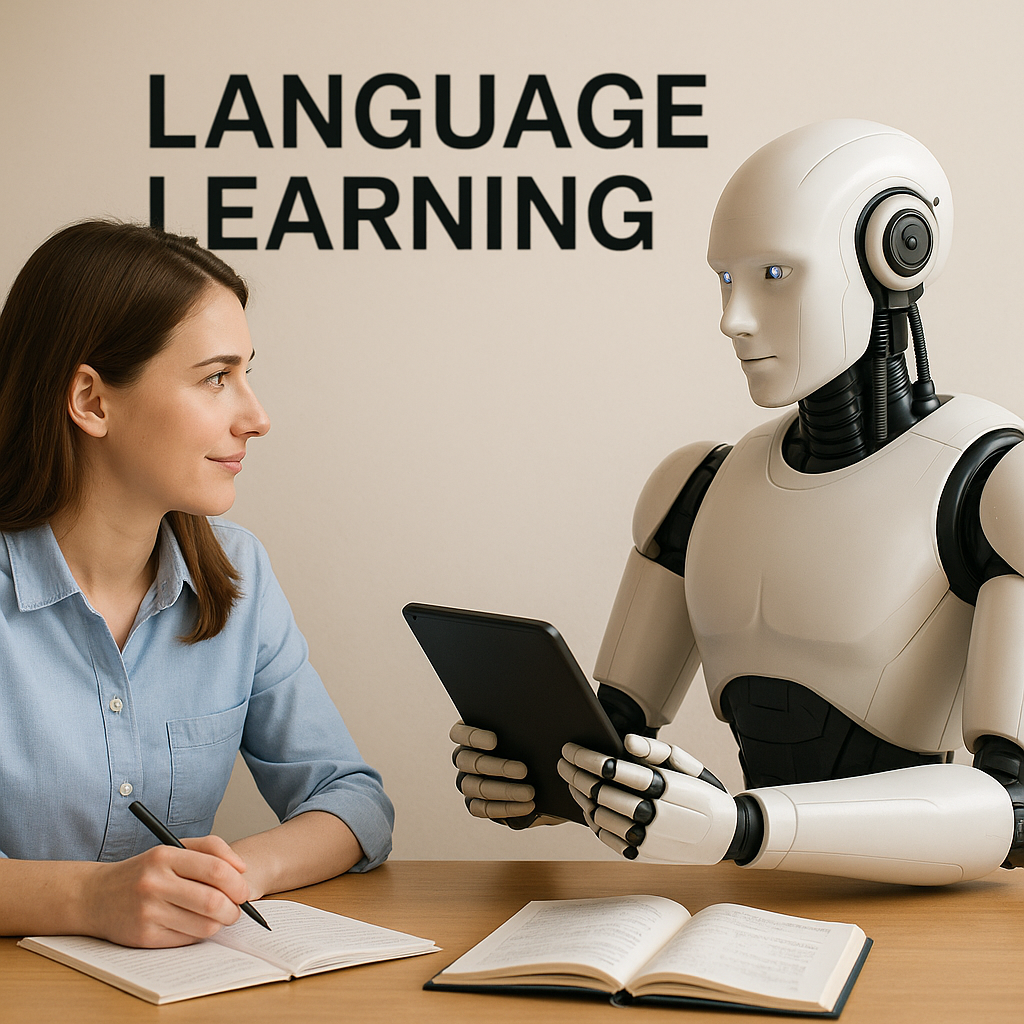
The development of Artificial Intelligence (AI) is progressing at such a speed that its impact can now be felt in almost every area of everyday life. From self-driving cars to diagnostic systems, language translators, automated text generation, and even the creation of presentations, AI is gaining ground everywhere. But will the moment come when a robot teacher stands at the lectern in a classroom? And if so, how should we imagine it?
AGI and AI?
According to experts, today’s AI systems are still only optimized for specific tasks, known as Artificial Narrow Intelligence. The real turning point would come if Artificial General Intelligence (AGI) emerged—a type of intelligence capable of performing any intellectual activity, task, and cognitive function that humans can currently achieve. This would mean AI being able to draw complex conclusions, make inferences, acquire new knowledge, or make situational decisions, rather than simply acting in exact, predefined ways.
Let’s play with the idea through an extreme example. Imagine a law-enforcement robot, armed with a weapon, spotting a bear chasing a child in a crowded park—say, in the town of Biatorbágy.
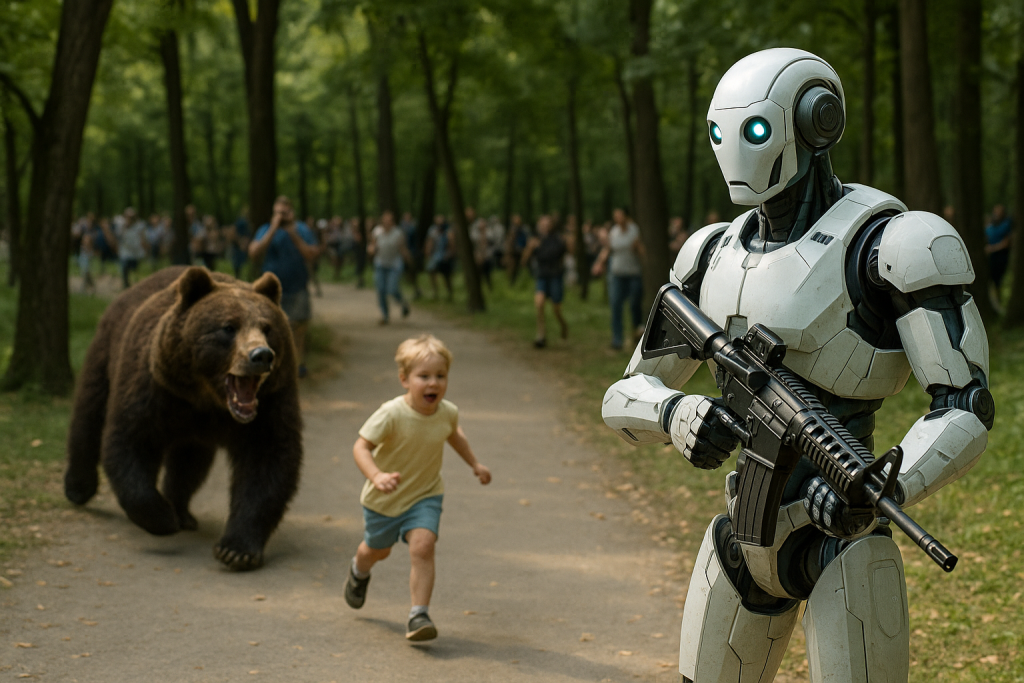
The robot has been programmed with exact rules such as:
1. Do not kill a human
2. Do not kill an animal
3. Do not use a weapon among people, etc.
The child can only be saved if the robot is capable of drawing conclusions, performing risk assessments, and evaluations. In other words:
4. The bear is capable of killing the child; it is chasing the child, perhaps intending to do so.
5. If the bear is shot, the danger disappears.
6. Human life and the interest of saving the child must come first, overriding rules two and three.
As a result, the child is saved—but then the evening news reports that a “corrupt” robot shot a father dressed as a bear, who had only been chasing his child for fun, in costume.
So, the robot should also have drawn new conclusions—things that a mature, critical, rational human would immediately recognize:
7. There are no bears in Biatorbágy.
8. Analysis: This is not a real bear (the costume might be good, but movement, sound, etc. give it away).
With a touch of humor, we might even ask: if AI learns to imitate human emotions, could it get angry at the man photographing the child instead of protecting the child—and end up targeting him?
AGI and LEARNING / TEACHING
The emergence of AGI would radically transform learning as well. It would not only transmit information or correct mistakes but could adapt to the student’s style, pace, and even emotional state. Of course, a good teacher can also do this—but a teacher can have a bad day, a headache, or simply be tired. Robots, on the other hand, do not have these human limitations; they are emotionless.
All of this sounds unsettling. How many of us teachers can sense our students’ emotional state during a short warm-up, and then pull out a more suitable lesson plan or activity to lift the mood? And what happens if we, the teachers, are not having a particularly good day? Often, external or internal factors shape our mood, which in turn determines what will happen in the next 45 minutes and how effective the lesson will be. That’s no surprise—it’s human nature, the human soul at work. Everything has an effect: our students, their behavior, and the classroom atmosphere.
AI, however, has no soul. “It” always remains the same in every situation. Always predictable, always “perfect.” Which raises another question: can even a single lesson truly take place without the presence of the human soul? In education, the presence of the soul is a link, a vital chain without which teaching and upbringing are, at present, unimaginable.
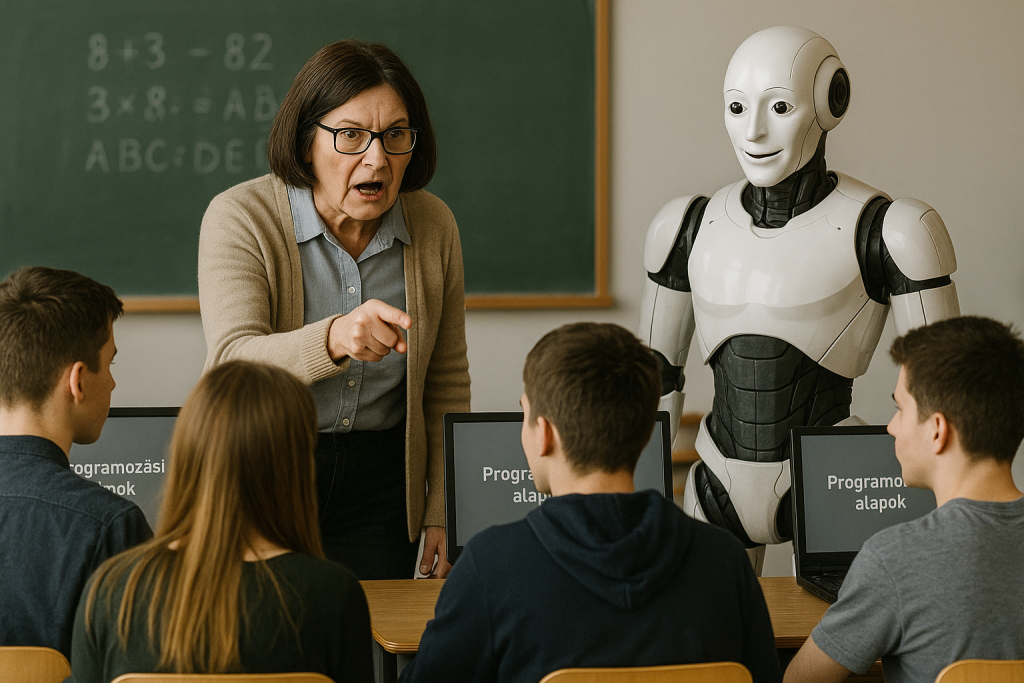
The soul connection between teacher and student is also essential. Many of us have experienced teachers who instilled fear and anxiety in us—effects that can last a lifetime. But the opposite is also true: meeting an inspiring teacher, perhaps in history class, might inspire a student to become a teacher or a writer. On the other hand, encountering an aggressive teacher in physics, math, or chemistry at an early stage can discourage students, weaken their foundations, and close off a future engineering career.
One thing seems certain: yelling robots will probably not be part of the future, as parental and societal acceptance of that would be unthinkable.
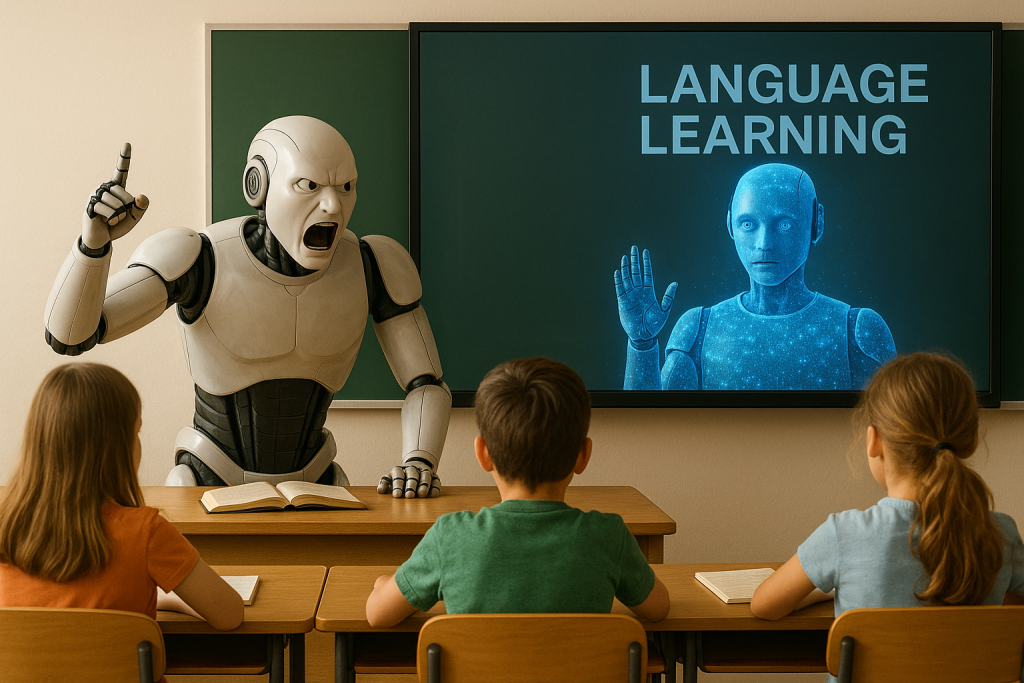
The Teacher, the Soul, and AI
As teachers and educators, we might ask ourselves: how will AI handle school discipline and the inner world of children in the future? Will it be capable of differentiation, appropriate solutions, and actions when facing students with special educational needs (SEN) or behavioral and learning difficulties?
Of course, it is unimaginable that young students would ever be left alone with a robot in a classroom. It is also hard to picture robots roaming between desks—at least for now. At the same time, it is equally unimaginable for educational institutions to lag behind in digital development, as technological progress is unstoppable.
Teacher competencies must intertwine with digital education, including the possibilities offered by AI. It’s not just about what tasks AI can make easier for teachers, but also about what AI-related projects or assignments we can give students—whether in classwork or long-term projects. Are teachers ready to keep up the pace? Do they have the will, creativity, dedication, and above all, the interest to adapt their lesson plans and conventional methods?
In the Digital Promised Land, ready-made solutions abound. And yet, today’s situation might be best compared to giving someone a wooden spoon and asking them to cook. The obvious questions would be: what to cook, in which pot, with what ingredients? Similarly, a teacher now asks: which app or program should I use? For what purpose? When and how? And another crucial question: with what kind of institutional subscription?
A teacher may know about the apps available on the market, may know what ChatGPT, Gamma, or DALL·E are—but that doesn’t guarantee they can find the right way to integrate them effectively into teaching practices. While there are plenty of AI-related educational programs, there are very few honest, targeted courses tailored to specific subjects, from which teachers could draw inspiration and practical knowledge.
Many fear that technology will replace teachers in schools. But according to educational researcher Dr. Judit Kelemen, such a thought is misleading: teachers’ roles will not disappear—they will only transform.
Thus, Digital Uncertainty is not just part of elderly people’s lives but also of teachers’ lives, as we stand at the dawn of the AI revolution. This new world calls us to creativity.